Why MSP platforms are the next evolution of managed services
How managed service providers (MSPs) can reduce complexity and build a more scalable foundation for managed services
Key takeaways
- MSP platforms are becoming a strategic foundation for improving efficiency, profitability and service consistency.
- Fragmented tool stacks can slow delivery, increase overhead and make it harder for MSPs to scale.
- AI readiness depends on connected data, integrated workflows and stronger operational visibility.
MSPs are entering a pivotal operating-model shift: The providers that can simplify delivery, connect data and scale services efficiently will be better positioned to protect margins and meet rising customer expectations. A new e-book developed by Channelnomics for Global MSP Day shows why many MSPs are moving toward platform-based models as a foundation for long-term growth, stronger cybersecurity outcomes and more resilient service delivery.
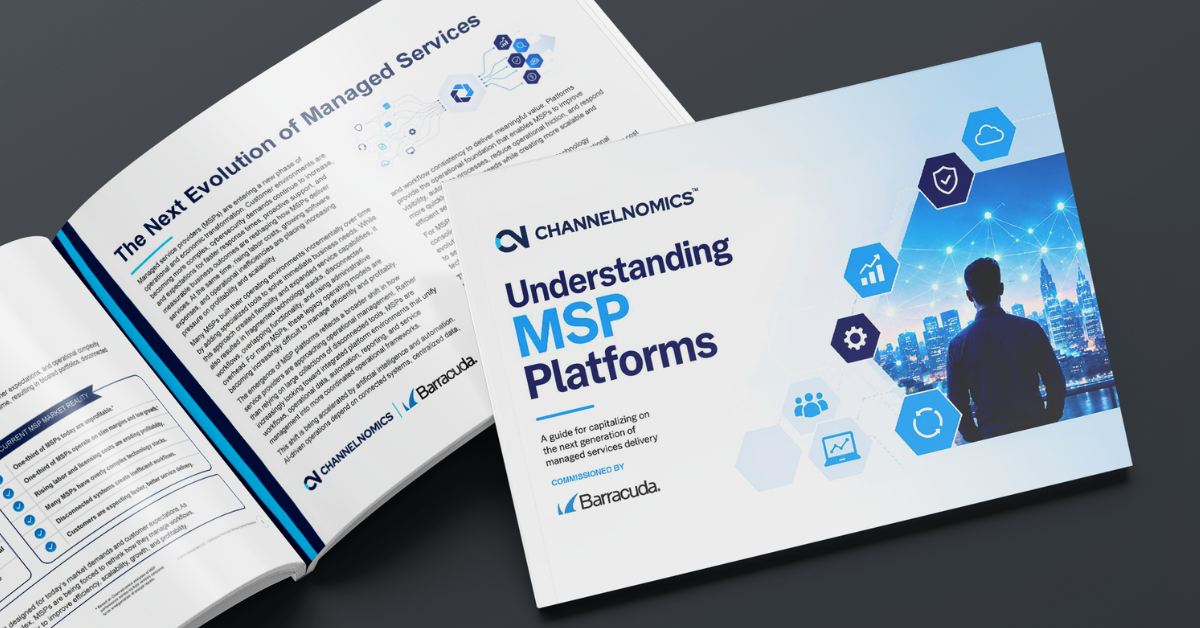
The e-book, The Next Evolution of Managed Services, examines how platform strategies are moving from a back-office efficiency discussion to a strategic requirement for MSPs that need to compete in a market shaped by AI, security complexity and demand for faster, more consistent outcomes.
Why are MSPs shifting to platform models?
Many MSPs built their technology environments over time, adding point tools as new customer needs emerged. That flexibility helped them adapt, but it also created harder-to-manage stacks with disconnected workflows, duplicated capabilities and more administrative overhead.
The result? Operational friction that makes it harder to scale efficiently.
According to the e-book, MSPs are now evaluating how to consolidate tools, standardize workflows and improve visibility across operations. Instead of managing fragmented systems, they are looking for integrated environments that connect data, automation, reporting, security, and service management in a more unified operating model.
What fragmentation is costing MSPs
One of the key themes explored in the e-book is the impact of fragmented technology stacks.
When technicians move between multiple tools, manually transfer information or work from siloed data sources, service delivery slows and margins come under pressure. MSPs may also absorb added costs tied to training, administration, vendor management, and licensing, while visibility gaps make it harder to standardize processes and scale consistently.
As customer environments grow more complex, these challenges become increasingly difficult to ignore.
Why AI makes platform readiness urgent
The rapid adoption of AI is adding a new dimension to the conversation.
As the e-book explains, AI-powered operations depend on connected data, workflow consistency and operational visibility. AI tools can help MSPs identify emerging issues, uncover insights and accelerate decision-making — but only when relevant information is accessible and integrated.
That makes platform readiness a competitive issue, not just an IT architecture decision. The report argues that platforms can provide the connected data and operational context MSPs need to turn AI and automation from isolated experiments into practical drivers of service quality, productivity and scale.
Why platforms are a business decision
While technology consolidation often captures attention, the broader discussion is ultimately about business outcomes.
The report examines how platform-based approaches can help MSPs:
- Improve operational visibility
- Simplify workflows
- Reduce complexity
- Lower administrative overhead
- Accelerate service delivery
- Create more scalable operating models
In other words, this isn't simply about replacing tools. It's about building an operating foundation that helps MSPs compete on speed, consistency, profitability, and adaptability as customer needs and threat conditions continue to change.
Read the full e-book
The managed services landscape is evolving quickly, and platform strategy is becoming central to how MSPs improve efficiency, profitability and customer outcomes. For leaders planning around AI adoption, margin pressure and rising service expectations, the Channelnomics e-book offers a timely look at one of the industry's most important operational shifts.
Download and read the full e-book to learn why platform-based operating models are gaining momentum and how MSPs can prepare for a more connected, AI-enabled and scalable future.







Subscribe to the Barracuda Blog.
Sign up to receive threat spotlights, industry commentary, and more.