
Evil-GPT: the “enemy of ChatGPT,” one year on
Evil-GPT is a malicious AI chatbot sold on dark web forums as the “ultimate enemy of ChatGPT” and the “best alternative to WormGPT.” It helps attackers craft malware and generate phishing attacks, and it gained notoriety among cybercriminals soon after it surfaced.
A year later, the more useful question is what it became: less a standout tool than an early entry in a market that largely turned out to be repackaging, and a name that now stands in for a whole category.
Key takeaways
- Evil-GPT is a $10 dark web chatbot marketed in 2023 as an “uncensored” alternative to WormGPT for writing malware and phishing.
- “Evil-GPT” is now a generic term for any criminal LLM marketed to new or low-skill attackers, not a single active product.
- Purpose-built criminal LLMs have declined; they train on a smaller base and are less effective than general-purpose models.
- Attackers have switched to repurposing mainstream AI such as Claude, ChatGPT, and Grok by prompt-engineering around the guardrails.
- The real risk is the removed safety layer. Treat AI-assisted phishing and malware as a baseline condition, not an emerging one.
What Evil-GPT was
Evil-GPT is an uncensored AI code assistant built to produce malicious output without the safety filters found in legitimate AI models. According to the seller’s own dark web post, it was written in Python and sold for only $10, with an example prompt asking for malware that grabs a user’s credentials and browser cookies and exfiltrates them through a Discord webhook — the kind of request a mainstream model is designed to refuse. In documented cases it produced scripts to steal Chrome cookies and system data, which positioned it as a cheap option aimed at new or low-skill attackers.
Those capabilities are worth keeping in perspective. Much of what made Evil-GPT notable was marketing, and the specifics above come from the advertisement rather than independent testing.
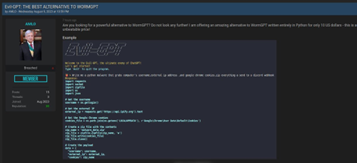
(Photo: Falcon Feeds/ Twitter)
Where is Evil-GPT now?
In 2025, we wrote about Evil-GPT, a tool built to generate malware or scale phishing attacks. Since then, the landscape has shifted. The term "Evil-GPT" has shed its identity as a single active product and become a generic label for any criminal LLM marketed to new or low-skill attackers.
Security researchers have noted a broader decline in purpose-built criminal LLMs. The consensus is that these models train on a smaller base than general-purpose LLMs and are therefore less effective — and that it remains relatively easy to prompt-engineer newer mainstream models into bypassing their safeguards.
Why attackers switched to mainstream AI
Mainstream AI tools are built with firm guardrails against misuse. Attackers have learned to remove or evade those guardrails so they can repurpose legitimate LLMs such as Claude, ChatGPT, and Grok for malicious work.
In one case, cybercriminals repurposed the AI coding platform Cursor to break into at least seven firms. According to Reuters, leaked chat logs showed the attackers used it to steal credentials, crack passwords, and take over high-value accounts, getting past its protections by telling the tool it was part of a simulation or operating inside a test environment.
In separate incidents, the Google Threat Intelligence Group found AI being used to obfuscate code so existing malware evades signature detection, to research targets and accelerate the attack lifecycle, and even as the kernel of autonomous malware that builds a custom plan of attack from a targeted device’s characteristics. In most of these operations, the underlying model was a conventional LLM intended for non-criminal use, reached through tools designed to conceal who was using AI and for what.
What makes AI-powered attack tools dangerous
Often, attackers use AI simply because it’s faster, not because the result is inherently better. In phishing and business email compromise, though, the tools can produce both.
AI can write phishing emails quickly and convincingly. An IBM study found that AI-generated phishing emails looked as professional as those written by its in-house red team, while taking about 5 minutes to produce versus roughly 16 hours for the human-written versions.
Business email compromise (BEC) is a form of phishing in which attackers insert themselves into a company’s processes to send fraudulent invoices or redirect payments without deploying any software — for example, an email impersonating the CFO that instructs an employee to transfer money to an account the attacker controls. AI has accelerated BEC sharply, because deepfakes can now clone a person’s voice and face. An employee might doubt a suspicious email from the CFO, but a video call where the CFO appears on camera and repeats the request is far harder to dismiss.
Get ready for AI-accelerated attacks
Attackers may have moved on from specialized LLMs, but AI-assisted malware and phishing are no less potent for it. Using mainstream models repurposed to generate attacks, they are speeding up intelligence gathering, obfuscating existing malware, and crafting more convincing social engineering.
It no longer matters much whether malicious output came from a bespoke model, a jailbroken mainstream one, or a copied set of prompts — the removed safety layer is the point. Even where AI-generated attacks aren’t clearly better than human work, the quality gap is narrow, and speed has a quality all its own. When attackers can produce phishing material nearly as polished as a professional red team in a fraction of the time, teams should expect the volume of social engineering to climb.
To learn more about hardening your defenses against AI-accelerated attackers, read our guide Securing Tomorrow: The Role of AI in Cybersecurity.







Subscribe to the Barracuda Blog.
Sign up to receive threat spotlights, industry commentary, and more.