

SafePay: Email bombs, phone scams and really big ransoms
SafePay has grown from a ransomware newcomer into a persistent global threat, combining social engineering, credential abuse, vulnerable systems, data theft, and encryption.
Key takeaways
- A fast-rising ransomware operation has become a persistent global threat. International authorities describe SafePay as one of the most active ransomware groups of 2026, affecting hundreds of organizations across multiple sectors and regions.
- There is no single route into a SafePay attack. The operation has used compromised credentials, vulnerable internet-facing systems, phishing and social engineering, including email bombing and fake technical-support contacts.
- Data and recovery are both targets. SafePay steals data, encrypts systems and interferes with backups to increase pressure on victims, making identity security, patching, administrative controls and recoverable backups important parts of ransomware defense.
When it comes to choosing a brand name, “SafePay” must be among the most boring of choices. It sounds more like a payment app than an organized crime group. There are no dragons or bugs or heads full of snakes, but the group behind the brand is skilled and ruthless.
SafePay combines data theft and encryption with aggressive extortion, with hundreds of victim claims across 51 countries. In October 2026, a Joint Cybersecurity Advisory by U.S., U.K. and German authorities described SafePay as one of the most active ransomware groups of 2026.
SafePay ransomware was first publicly observed in 2024 and has since been confirmed active since at least August of that year. By the end of the first quarter of 2025, the group had claimed more than 200 victims. Its activity surged in spring 2025, but SafePay did not disappear after that rapid growth. Public leak-site tracking listed 621 SafePay victim claims as of November 5, 2026, including 31 claims during the preceding 30 days. As with all ransomware leak-site data, these claims should not be treated as independently confirmed intrusions.
Who is SafePay?
Let’s start with the brand. “SafePay” sounds more like a payment service than a ransomware operation, but there is no publicly documented explanation for the name or evidence that it has any particular significance to the group. The group’s operators refer to themselves as the “SafePay team.”
Available research indicates that SafePay operates as a closed ransomware group rather than a conventional ransomware-as-a-service (RaaS) program. The operation does not appear to openly recruit affiliates, with the same core team instead handling intrusion, data theft, ransomware deployment and negotiations.
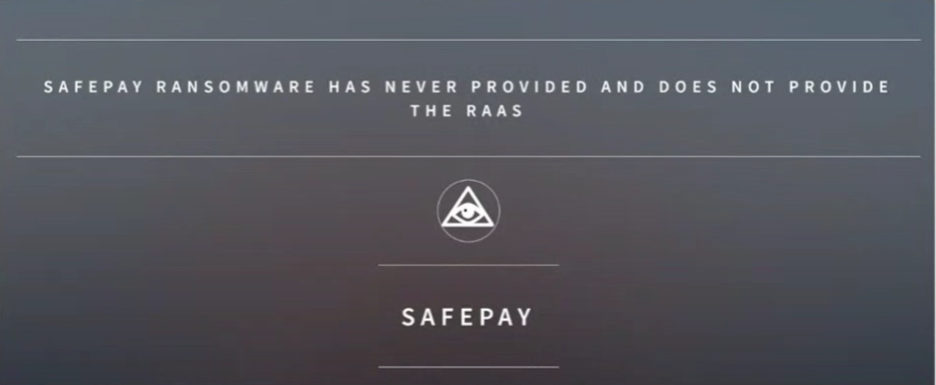
SafePay data leak site, via DCSO
SafePay’s ransomware has significant technical overlap with the leaked LockBit Black, or LockBit 3.0, codebase, including similarities in its encryption logic and command-line options. But LockBit source code and builders circulated beyond the original LockBit operation, so the similarities do not establish that SafePay is a LockBit successor or that former LockBit members operate it.
There is no publicly confirmed location for the SafePay operators. The ransomware includes an execution check intended to prevent it from encrypting systems configured with certain Cyrillic-language settings. This type of “kill switch” has appeared in other ransomware families, but it does not establish where SafePay’s operators are physically located.
Early victim data showed significant activity in the U.S. and Germany. The operation has since demonstrated a much broader geographical reach, with authorities documenting affected organizations across North America, South America, Europe, and Australia.
SafePay, email bombs and phone scams
Earlier reporting on SafePay associated the group with social-engineering attacks in which employees received a flood of spam messages and were then contacted by someone impersonating technical support.
The technique creates a problem and then offers the attacker as the solution. An employee trying to deal with hundreds or even thousands of unwanted messages may receive a Microsoft Teams message or call from someone posing as technical support. The fake support representative offers to fix the problem and attempts to persuade the employee to provide remote access through a legitimate support tool such as Microsoft Quick Assist.
The technique remains active beyond SafePay. Incident responders in 2026 have continued to document email bombing followed by fake IT contacts over Microsoft Teams and attempts to obtain remote access through Quick Assist.
The help desk as an attack vector
There’s something important about the fake help-desk scam beyond SafePay: It turns the organization’s support process into an attack vector.
The attacker is counting on the employee not knowing the difference between legitimate technical support and someone impersonating it. Employee awareness helps, but organizations also need a trusted way for employees to verify unexpected support requests, particularly when they’re already under pressure.
Social engineering is only one route into a SafePay attack. Authorities have also documented credential abuse and exploitation of vulnerable internet-facing systems. The email-bomb and fake-help-desk sequence is therefore best understood as one technique in a broader initial-access toolkit.
SafePay attack chain
SafePay does not depend on a single route into a network. Authorities have observed the operators using stolen or phished credentials, password attacks, compromised VPN access, and exploitation of vulnerable internet-facing systems. Documented vulnerabilities include CVE-2020-3259, CVE-2023-20269, CVE-2023-27532, CVE-2024-40711, and CVE-2024-40766.
Once access is established, a SafePay intrusion may move through several stages:
Account control and persistence: SafePay operators may take over existing accounts or create new ones, giving the operation continued access and, where possible, administrative privileges.
Discovery and lateral movement: The operators use legitimate administrative capabilities to explore the environment, identify valuable files, and move between systems. Observed tools and protocols include PsExec, Windows Remote Management, and Remote Desktop Protocol. Because these capabilities also support legitimate IT work, defenders need to evaluate who is using them, from where, and for what purpose.
Defense evasion: SafePay attempts to disable security protections before deploying the ransomware, reducing the likelihood that its activity will be detected or stopped.
Data collection and theft: The operators identify, prepare, and steal valuable information before encryption. The stolen data gives SafePay additional leverage because the group can threaten to publish it even if the victim can restore affected systems.
Recovery disruption: SafePay deletes or disables backups to make restoration more difficult and increase pressure on the victim. This makes backup administration and recovery infrastructure part of the attack surface, not merely the response.
Encryption and extortion: SafePay encrypts files and leaves a ransom note demanding payment. The group threatens to publish stolen information if the victim does not pay and, in some cases, SafePay representatives have called victims directly to increase pressure during the extortion process.
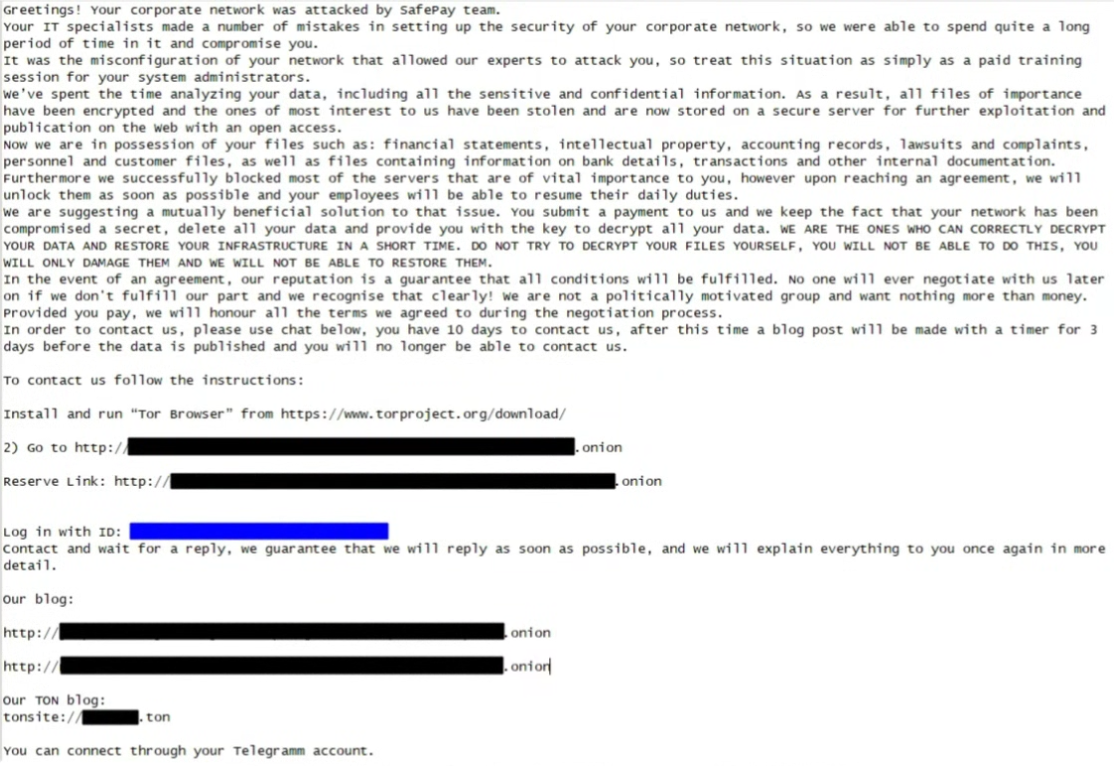
SafePay ransomnote, via DCSO
Motivation and notable victims
SafePay is a financially motivated ransomware operation, and the group itself has been unusually straightforward on the subject. Its ransom note states:
We are not a politically motivated group and want nothing more than money.
SafePay reportedly tailors ransom demands to the victim, using financial information such as company revenue to help determine how much to demand.
One of the most high-profile incidents attributed to SafePay was the July 2025 attack on Ingram Micro, a major global technology distributor and services company. The incident disrupted ordering and other business systems for several days. SafePay subsequently claimed responsibility, although Ingram Micro has not publicly attributed the attack to the group. Subsequent breach notifications confirmed that files containing personal information belonging to 42,521 current and former employees and job applicants were taken during the incident.
SafePay has also targeted or claimed organizations across industries ranging from manufacturing and healthcare to education, logistics, financial services and government. Manufacturing accounted for the largest number among claims where an industry could be identified, while Germany and the U.S. accounted for the largest numbers among claims where a country could be identified.
Protect yourself
SafePay’s attack chain brings together several familiar ransomware risks: vulnerable internet-facing infrastructure, compromised credentials, abused administrative tools, social engineering, data theft, encryption, and attacks against backup systems. There is no single control that addresses all of them.
Keep internet-facing systems patched. Organizations should keep operating systems, applications, firmware, firewalls, VPN appliances, and other edge devices updated. CISA specifically recommends prioritizing patches for internet-facing infrastructure and vulnerabilities known to have been exploited in SafePay attacks. Review the joint SafePay advisory from CISA and its partners.
Protect identities and privileged access. Identity deserves the same attention. Require multifactor authentication for remote and privileged access, using phishing-resistant methods where supported. Restrict administrative privileges to users who need them, monitor for compromised credentials, and investigate suspicious authentication activity. Because SafePay can operate through valid accounts, a successful login should not automatically be treated as a trustworthy login.
Control remote administration. Organizations should also restrict remote administration capabilities to approved users and systems. Monitor for unusual use of tools and protocols such as Remote Desktop Protocol, PsExec, Windows Remote Management, and remote monitoring and management software. These capabilities are legitimate, so detections should account for the user, device, source, timing, and purpose of the activity rather than treating the presence of a tool as evidence of compromise.
Prepare employees for social engineering. Human defenses matter, too. Employees should know how to verify an unexpected call, Microsoft Teams message, or technical-support request through a separate, trusted channel. An email flood followed by someone offering to “fix” the problem should raise suspicion rather than trust.
Protect the recovery process itself. Separate backup administration from the production environment, use distinct accounts and authentication for backup systems, and restrict access to authorized administrators. Maintain immutable or offline backup copies where appropriate and regularly test full restoration. If an attacker can destroy the backups along with the production environment, having a backup strategy on paper will not be enough.
Barracuda can help
SafePay demonstrates why ransomware defense has to extend beyond detecting the ransomware itself. Organizations need to stop phishing and social engineering, protect accounts and applications, identify suspicious activity and keep critical data recoverable. BarracudaONE brings these layers of protection together, providing centralized visibility and security across email, identity, applications, networks and data.






Subscribe to the Barracuda Blog.
Sign up to receive threat spotlights, industry commentary, and more.
